
Rum
A turbulent history

One of the most versatile spirits that one can find behind a bar, full of lore with pirates, navy and triangles of death. This is the story of one tasty drink.
6000BC Papua New Guinea.
We start this story with the origin of the sugarcane, or saccharum officinarum as the Latin name is. The origin in it sense, that that’s when botanists have found hard evidence the plant was cultivated first.
Not so much for it’s sweetness as for it ability to be used as a building material; like bamboo, the plant grows fast, is adaptable to the soil, so eventually it will grow anywhere and it is sturdy. It would’ve made sense that it was used in trade during this time amongst different islands around PNG.
It wasn’t for long that a hybrid came about that was slightly smaller. Around the 15th century when the first Europeans came around (the Spanish in this case) took some of it with them, and planted it their colonies, the Canary islands and west Africa.
Columbus and cane.
On his second voyage to the New World in 1493, Christopher Columbus took sugarcane with him and brought it to the Caribbean to cultivate the cane. With him he had Arabic prisoners to work in silver and goldmines.
The Spanish went to the Caribbean and settled there in the hope to find Silver and Gold. They did not find any silver and gold, but they did find that sugarcane was easy to cultivate: a cane would germinate in under 7 days because of the climate on the Caribbean islands.
It was in the year 1516 that the first sugar was presented from the Caribbean to the king of Hispaniola.
This sugar was presented to him by a man hired to inspect gold mines, but considering there weren’t any he had nothing better to do then to produce sugar. Sugar was a foreign substance and it was therefore seen as a luxury item which Kings would love to show of to their guests. It would take another 200 years for sugar to fully boom in Europe amongst the ‘common’ people.
There was one problem though; life on the plantation was hard; people worked in the blistering heat for hours. Snakes and bugs would hide between the sugarcane, and to get the maximum profit out of a sugarcane, the cane needs to be cut as close to the ground possible, because that is where it holds the most sugar.
These circumstances, made life extremely hard and a lot of the people working on these fields would die within a couple of years. There weren’t enough prisoners to ship to the Caribbean and therefore the Spanish took people from Cape Verde, just of the coast from Africa, to the Caribbean to work the plantations; the first ship full of these slaves would set sail around the year 1510.
This was the start of the most dubious triangular trade in history that would last for over 200 years. Ships would sail from Europe to Africa, to trade goods for slaves, these slaves were sold for Sugar, Tobacco and Rum before the ships would set sail back to Europe.
Barbados shipwreck
We fast forward to the year 1609, the Caribbean are full of sugarcane and slaves. The voyage to the new world is very hard. The ship of Sir John Summer gets caught in a hurricane on the way to the New World, and hits a deserted Island; Barbados.
He plots this Island on the map, and as it turns out, the island is strategically placed: It is the closest to Europe. It becomes a hub for the Caribbean and Europe, ships would get into the harbour, top up on water and food, have a rest and then move on to their destination.
The settlement on Barbados would grow bigger, and is now known as the capital ‘Bridgetown’. English being English, at one point they will start to ferment. And distil that ferment. And almost certain is that it was on Barbados; Kill-devil, or rum bullion was created somewhere around 1630.
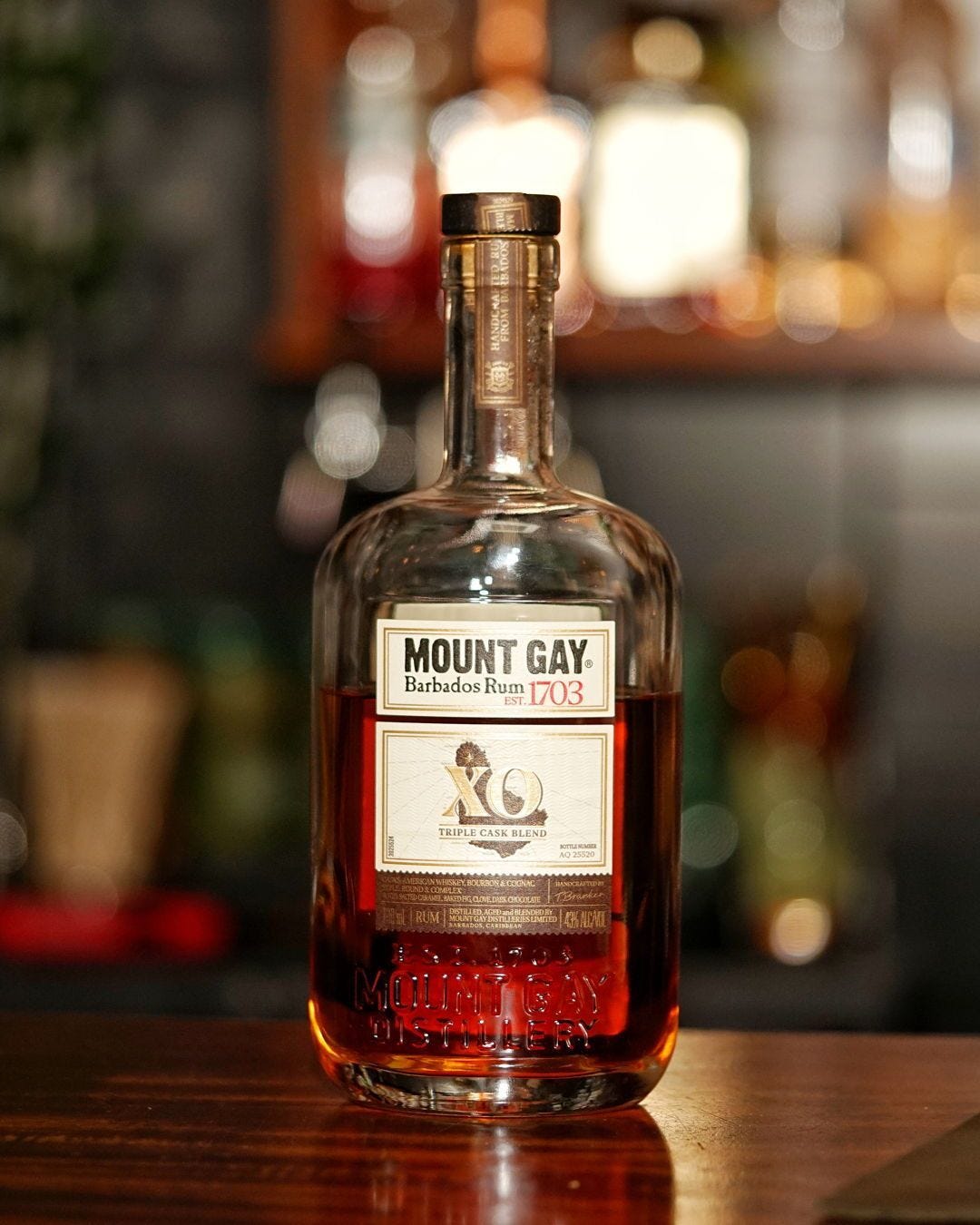
The oldest Rum distillery in the world, and still active, is the Mount Gay distillery in Barbados, dating back to 1703.
European wars in the Caribbean.
Due to the strategic location of the Caribbean, all the big European players wanted an island so close to the America’s. Throughout the years, the Spanish - who where only interested in silver and gold - where replaced by the Dutch, the English and the French.
The new invaders would build sugarcane plantations, bring in slaves, and cultivate.
Proof and Grog.
Sugar became more and more popular in Europe, therefore more traffic on the seas. Rum was the choice for the man on sea because it was not as perishable as beer and wine. And to keep your man distracted from the shortage of vitamin C, the long days, and the with that coming diseases; you get them drunk. With Rum that goes a lot easier, so easy that the pint of rum a day was too much; the crew would be too drunk to do anything. Ship Captains would cut the rum with water. But that was in protest of the sailors. So what they would do to proof that the rum was strong enough; they would mix it with gunpowder; if it would ignite, that was a 100 proof. The Americans still use the word ‘proof’. 100 proof equals 50% ABV.
One of the first people to dilute the rum, in 1740, was Admiral Edward Vernon. Who was always seen wearing a grogram cloak, a cloak made out of silk and wool, stiffened with gum. He was therefore given the nickname “Old Grog”. And now you can guess how where the term ‘grog’ came from: the diluted rum rations prescribed by “Old Grog”.
Don Facundo Bacardi
A very important year for rum was 1862, the year the game of producing rum was changed by 1 man; Don Facundo Bacardi Masso. He is the grandfather of the rums as we know now. He pioneered 4 techniques;
Purposeful aging; putting the liquid into barrels to
Charcoal filtration
Dual process - blending
Single yeast strain
His revolutionary way of producing rum raised the standard for all the rums. With his ‘rum of the bat’
The Types of Rum
Rum does not have an appellation unlike champagne or tequila, it can be made everywhere in the world. Each country has it’s own rules and regulations, therefore there are many different styles of rum, but as a general rule of thumb:
English style Rums - made from molasses, a by-product of making sugar. Bold, full of flavour, mainly uses pot stills.
Spanish style Rums - made from molasses, mainly uses column distillation, creating a more delicate style of rum.
French style Rums - made from fresh sugarcane juice and combination of stills, earthy/grassy flavours.
Spiced rums - made from molasses, could be a variety of stills, flavoured with spices.
Remember; next time you are in a bar ordering a Daiquiri or rum Old fashioned, you are ordering centuries of stories, mixed in a glass.
Want to get the next deep dive in your inbox? Subscribe!